
Business analytics software increasing due to Low Cost & Enhanced Usability


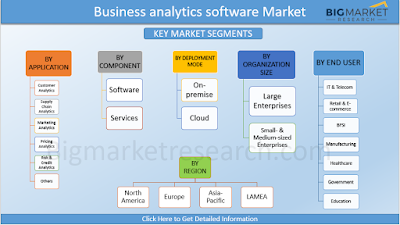
 Business analytics software conducts predictive analysis to derive decision-making inputs and insights through the application of statistical tools and methods in business performance data. It analyzes business data and information through continuous investigation and exploration of old business performance data to obtain decisive insights for business planning. A business analytics software helps an organization to optimize business operations and facilitates strategic decision-making. The outputs are mostly used by financial analysts, managers, security personnel, and key decision makers of organizations. The demand for cloud-based business analytics software is increasing among small- and medium-sized enterprises chiefly due to its low cost and enhanced usability.

Request for Sample Copy @ https://bit.ly/3gRxTjw
https://bit.ly/3gRxTjw


The growth of the global business analytics software market is driven by factors such as increase in adoption of business analytics software by multiple organizations, surge in demand for cloud-based business analytics software among SMEs, and numerous benefits provided by business analytics solutions. In addition, ability of business analytics software to deliver enhanced & faster decision-making and to provide competitive advantage by analyzing and acting upon information in a timely manner propel the growth of the industry.

The global business analytics software is dominated by key players such as IBM Corporation, Fair Isaac Corporation, SAP SE, Microsoft Corporation, Oracle Corporation, Salesforce.com, Inc., SAS Institute Inc., Adobe, Qlik, and Google LLC.

Comments

Popular posts from this blog

Development: Aerospace 3D Printing Market Strategy Planning by Top Manufacturers

  Aerospace 3D Printing Market Analysis 2026: According to a study of the Research Dive,  aerospace 3D printing market  forecast shall cross  $5,933.4 million by 2026 , growing at a  CAGR of 26.8%  during forecast period. Aerospace 3D printing is primarily used to increase the efficiency of A&D supply chain, reduction of storage costs of inventory and waste production materials. Furthermore, the Aerospace 3D printing industry is focusing more on creating parts of aircraft that are lighter and stronger than parts made by using traditional manufacturing. Astonishing advantages of 3D printings in the supply chain of the aerospace and defense industry are projected to surge in the global market. In addition, the financial support provided by the government and non-government organizations across the globe is also driving the 3D printing in aerospace industry. For instance,   National Aerospace Technology Exploitation Programme grants £140,000 funds for...

A Deep Dive into Building Efficient RAG Systems

  When  creating a RAG (Retrieval Augmented Generation) system , you infuse a Large Language Model (LLM) with fresh, current knowledge. The goal is to make the LLM's responses to queries more factual and reduce instances that might produce incorrect or "hallucinated '' information. A RAG system is a sophisticated blend of generative AI's creativity and a search engine's precision. It operates through several critical components working harmoniously to deliver accurate and relevant responses. Retrieval:  This component acts first, scouring a vast database to find information that matches the query. It uses advanced algorithms to ensure the data it fetches is relevant and current. Augmentation:  This engine weaves the found data into the query following retrieval. This enriched context allows for more informed and precise responses. Generation:  This engine crafts the response with the context now broadened by external data. It relies on a powerful language model...